

 Apple Podcasts
 YouTube
 Youtube Music
 Spotify
 Overcast
 iHeartRadio
 Amazon Music
 Audible
  RSS Feed
 Love Yourself Like Your Life Depends On It With Kamal Ravikant and Joe Polish
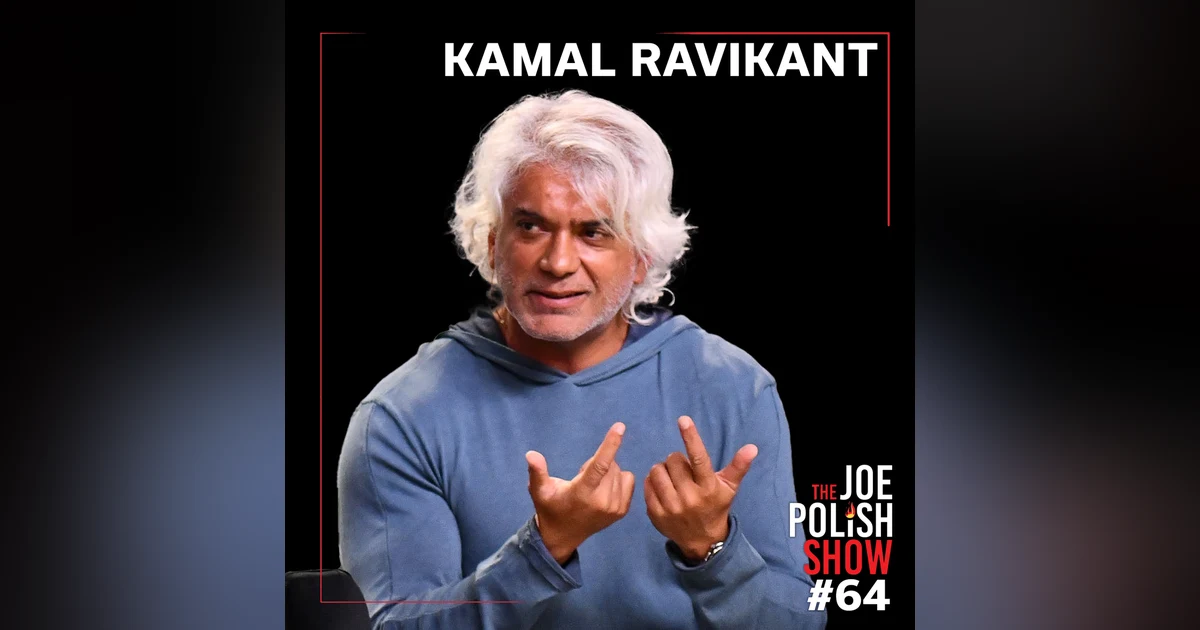
Joe Polish sits down with venture capitalist and Author Kamal Ravikant, for an unusually candid conversation about losing everything, the one-word vow that pulled him back from it, and what actually separates the investors who get rich from the ones who get wiped out.
Here's what you're about to discover in this conversation:
- Why Kamal Ravikant hit a point so low after losing every dollar of his company, and his investors' money, that he could barely stand the sound of his own head.
- The one-word vow Kamal made to himself alone in a room, never intended to write down, and why he treats a promise to yourself as sacred as a marriage vow.
- How his inner dialogue flipped from self-hatred to something he can only call magic in about a week and a half, with zero drugs or alcohol involved.
- The night at a private Silicon Valley wine bar when a still mostly unknown Elon Musk answered a question about the single most important advice for a CEO, and the two words that stuck with Kamal for decades.
- The mindset flip his mentor Bill Coons taught him that separates the angel investors who lose $750,000 to $1,000,000 from the ones who spot every hole in a pitch.
- How a $35,000 check Kamal wrote to an unproven founder on Skype in 2016 is now worth roughly $6,000,000, and the one portfolio rule he swears by so a single hit can outrun every loss combined.
If you'd like to join world-renowned Entrepreneurs at the next Genius Network® Event, apply today for your invitation to attend at https://geniusnetwork.com.
Show Notes
The Elon Musk Story From a Private Wine Bar
- Years before Tesla and SpaceX made him a household name, Kamal found himself in a small private Silicon Valley wine bar with about 20 people and Elon Musk.
- Someone in the group asked Musk for the single most important piece of advice he would give a CEO, and Kamal, stressed and overworked at the time, leaned in expecting something about cash flow.
- Musk's answer was to get rid of negative people, because keeping them on only lets them ruin everybody else around them.
- Decades later, Kamal still points to that moment as an early lesson in what it looks like to truly value yourself enough to walk away from what is not serving you.
Growing Up an Immigrant Kid in Jamaica, Queens
- Kamal was raised by a single mother in Jamaica, Queens, the neighborhood widely credited as the birthplace of hip hop.
- He explains the story behind his long last name and what it meant to grow up, in his words, as an immigrant child.
- He dropped out of college after a year and joined the U.S. Army, wanting to give something back to the country that had taken his family in.
Chasing His Brother Naval to Silicon Valley
- Kamal's younger brother, Naval Ravikant, went on to become globally known as an investor and thinker, and Kamal speaks candidly about what it is like being his older brother.
- He sold everything, bought a one-way ticket, and moved out during the late 1990s dot-com boom, doing what he calls too many things at once as a scrappy first-time founder.
Losing Everything: The Company That Blew Up
- After building his entire identity around being a successful Entrepreneur, Kamal ran a company for three and a half years that was doing great, right up until it collapsed.
- He was making payroll on credit cards before it finally fell apart, and he lost every dollar he had personally invested along with money from friends who had backed him.
- His own co-founder had turned down a top position at Google out of loyalty to the company, which only deepened Kamal's guilt once everything came apart.
The Vow That Changed Everything
- In the depths of what Kamal calls a dark night of the soul, he made himself a vow. Not to be great, not to be awesome, just to love himself.
- He treats a vow to yourself the way he treats a marriage vow: a sacred act that then obligates you to actually live it.
- He never read a single self-help book while working through it. He ran what he calls experiments with a sample size of one, keeping whatever worked and discarding whatever did not.
From Self-Hatred to Magic in About a Week and a Half
- Within roughly ten days of living his vow, Kamal's inner dialogue flipped from hating himself over the lost money and broken trust to something closer to love.
- No drugs or alcohol were involved. He is candid that he had done ayahuasca and other substances during his years in Silicon Valley, but this particular shift was pure mindset work.
- Once loving himself became his dominant inner conversation, his outer life began changing in ways he was not consciously trying to force, a feeling he can only describe as magic.
Deciding How He Feels, No Matter What Happens
- Kamal describes a more recent decision that he says has dramatically improved his quality of life: he no longer lets the world, social media, or a business outcome decide how he feels.
- He draws a hard line between reacting to life and responding to it, tying the word responsible directly back to being response-able, in control of his own state of mind.
- He points to Andre Norman and Elijah, who work with incarcerated individuals on building self-esteem and gratitude, as proof that this kind of internal rebuild is possible in almost any circumstance.
A Near-Fatal Surgery and What It Taught Him About Health
- In 2019, Kamal nearly died from complications tied to a cosmetic procedure and spent an extended stretch in a hospital bed hooked up to morphine.
- Even in that state, he leaned on the same internal practice, including visualizing himself healthy and fit again, without knowing for certain he would get the chance.
- Coming out the other side, he says he no longer takes his health for granted, and he now treats the whole ordeal as a forced lesson in gratitude.
The Hypnagogic Practice: Working the Mind at the Edge of Sleep
- Kamal deliberately works his mind during the hypnagogic state, the drowsy window right as he wakes up or drifts off, when most people let their thoughts run wherever they want.
- He fills that window with gratitude and love on purpose, including during the several minutes he spends hitting snooze most mornings.
- He compares directing the mind in this state to the Buddhist image of taming a wild elephant, and says the practice consistently makes him a better version of himself.
Killing the Old Man: Rebuilding Identity From the Inside
- Drawing on the mystic writer Neville Goddard, Kamal talks about needing to kill off the old man, the fear-based version of yourself, before a new version can exist.
- He admits he used to live in constant fear as an Entrepreneur: fear of failing, fear of looking bad, fear of not landing the next contract.
- The rebuild happens through pure repetition of a new belief, reinforced daily, which he compares directly to dog training.
The Investor Mindset vs. the Founder Mindset
- Kamal's mentor, Bill Coons, former president of the Silicon Valley angel group Sand Hill Angels, taught him that angel investing is one of the easiest ways to lose money.
- Coons observed that new angel investors typically lost somewhere between $750,000 and $1,000,000 before they actually started listening to guidance.
- Founders are wired to say yes to every problem and fall in love with an idea. Investors have to flip that instinct and go looking for every hole in the pitch instead.
- Kamal makes a point of never being the smartest investor in a room. He talks to the other investors in a deal first to understand their real reason for writing the check.
The Vercel Story: A $35,000 Check That Turned Into Millions
- In 2016, using a small first fund he was building a track record with, Kamal wrote a check over Skype to a then-unproven founder based in Argentina.
- That company was Vercel. Nine years later it raised funding at a valuation north of $9 billion and began letting early investors sell shares on the secondary market.
- Kamal's original $35,000 stake is now worth roughly $6,000,000 in liquid value, a return he says came from doing nothing except writing that first check.
- His takeaway: spread bets across many smaller checks in a portfolio rather than concentrating everything into one company, unless you truly know that space cold.
Reading the Warning Signs Before Money Destroys Someone
- Kamal points to writer James Altucher, who made and then lost a fortune, and to Altucher's own rule of not changing your lifestyle for at least a year after a big financial exit.
- He describes a well-known friend who once asked to borrow $250,000 to keep a $25,000-a-month Los Angeles apartment rather than simply move somewhere cheaper.
- The clearest warning sign, in Kamal's experience, is watching who starts spending time with someone the moment real money shows up, a dynamic he ties directly to what happened to Tony Hsieh.
Resources
- Love Yourself Like Your Life Depends On It | Kamal Ravikant's book on rebuilding self-worth after professional collapse.
- The Almanack of Naval Ravikant | A free collection of Naval Ravikant's wisdom on wealth and happiness, compiled by Eric Jorgenson.
- Never Split the Difference | Chris Voss's book on negotiation tactics drawn from his time as an FBI hostage negotiator.
- The Power of Now | Eckhart Tolle's guide to spiritual enlightenment, referenced as a formative read.
- Genius Network | Joe Polish's Genius Network